Saturday, April 25, 2015

Organization Extra: Professional Organizers

billyjoel.com
In the world of organizing, there are these wonderful creatures called professional organizers. They come to your house and consult with you about how to clear your clutter and live a more organized life. They offer classes and strategies and, I suspect, live in glass houses where there would only ever be a mess if someone threw a stone.

Needless to say (if you've been reading these posts), I'm not one of them. Throw a stone in my house and it's likely to end up on a pile of papers. But I'm working on it. And hey, my large rectangular spaces are looking good.

I took an online class on professional organizing once. It was interesting, but it made me squirm. Nowhere in it was there a word about following my style or my default habits. And as someone who's spent a great deal of her adult life trying to transform myself into a Type A organizer, I know the old tricks don't work for me.

But I know there are good eggs out there. Professional organizers like Julie Morgenstern and some of my HGTV favorites who don't have a leave-no-clutter standing rule at the expense of their clients' better judgment and favorite things. Organizers who send out newsletters and motivational emails and  sticky notepads with "Today I Will Do One Thing" imprinted on them. Organizers like my friend Cindy Bernstein at Aim 4 Order.

Okay, so Cindy and I have never met face-to-face, but we've chatted via email enough for me to know that if I were going to bite the bullet and hire a personal organizer, Cindy would be the first one I'd call. In the meantime, I subscribe to her e-newsletter and read all of her great ideas there and on Facebook. I especially like the fact that she suggests good homes for things I'm ready to say good-bye to...

...but more on the L of STYLE (Let it go!) next week.

Thursday, April 23, 2015

Throwback Thursday: Just One Thing

This post first ran on the Porch Swing Chronicles in December 2013. (There are no piles on my desk now :-) 

Sitting on my desk, amid haphazardly stacked papers and files is a cute little Post-it Note I got from professional organizer Cindy Bernstein:


Yesterday's note has four things crammed into the bottom section. On one I used last week, I ran out of room at the bottom and started filling in the white space around the words at the top.

Yes, I know that defeats the purpose. But in my defense, all of the things on the bottom were related. One category = one thing, right?

Wrong.

It's a wonderful concept, this determining the most important thing on the to-do list, then focusing on it, finishing it and checking it off. But, when multiple roles (mother, wife, writer, professor) converge, finding that one thing is a challenge.

I suppose I could use one note for each role, but I fear that by doing this, I am again defeating the purpose.

Of course, there's nothing on the note that says the thing I write down is the only thing I'm allowed to do...but that one thing often leads to another...and others present themselves as the day moves along (or careens by, as the case may be....)

Photo: pschubert via morguefile.com
And since I know I'm not the only person who finds herself in this predicament, I thought I'd share my strategy. It's very simple, really.

I'm going to use this notepad. I could just as easily use a piece of scrap paper, but since I have this cute little notepad, I'm going to abide by it. I'm going to write down the one thing I really want to get done before the day is over.

It won't stop me from making other lists, or cramming as much into a 24 hour period as I possibly can, but it will help me to check something off my list, at least once a day.

And who knows? Maybe I'll even write something fun on the list some days. 

I will do one thing today: Eat chocolate.  

godiva.com


Wednesday, April 22, 2015

Closets and Drawers, Part 2

npr.org
When I started writing these posts, I had three junk drawers. In one room.

In my defense, they weren't actually the traditional junk drawer with a hodgepodge of things from stray receipts to nail files to thumbtacks. Each drawer contained specific sorts of things, but the drawers themselves were a mess, separately and collectively. More junky drawers than junk drawers, they were clutter catchers, and, in the state they were in, they were a waste of prime real estate. The sad thing was that they'd been this way for years. I'd fallen into the habit of putting certain things in certain places, and I only realized how little sense it made when I needed space for a new crock pot and had to re-assess my available storage space.

No matter what room or piece of furniture they reside in, drawers are a blessing and a curse. Like closets, they are open, rectangular spaces, and as such, they make it far too easy to drop and run, cram and jam or stash our stuff "somewhere" -- and then close them and hide the evidence.

Regardless of our personal and organizational styles, large, rectangular spaces work best when we can see what's in them, which is one reason professional organizers frown on junk drawers -- singular or plural. Fortunately, there's one simple strategy that can make a difference. Like Give it Five! and Don't put it down, put it away! this idea can be personalized to fit your life and styles:

Divide and conquer.


evernote.com

Admittedly, I have an I need to see it bias, but I think the drawer organizer might be the best thing ever created. Okay, when you factor in caffeine and chocolate, it might only make the top ten, but my point is that simply subdividing the space inside that drawer so that you can see what you have makes the whole space work better.

Consider the flatware drawer in your kitchen -- forks, knives and spoons all neatly cocooned in their own little subdivisions. If we don't give a second thought to putting our flatware away that way, it's not such a leap to organizing our other rectangular spaces in a similar fashion.
thecontainerstore.com

Take my recently rehabilitated junky drawers. I have everyday flatware and nicer stuff. The everyday knives, spoons and forks live in the kitchen drawer described above. The nicer ones (now) have a home in a dining room drawer that wasn't subdivided. I lined the drawer with shelf liner and added narrow plastic bins from the dollar store. The drawer looked so good after I was finished that I periodically opened it up when I walked by just to see how organized it was.

The drawers in my bathroom are similarly divided with plastic (i.e. wipeable) bins of various depths and sizes so that when I open the drawer, I can not only see what I have, but I know where it goes when I'm finished with it, so I'm more likely to put it away.

Those bins at the end of last week's post? Yep. I got them -- or, more accurately, grabbed an unused one from the basement, purchased a second one in a contrasting print and ordered a third from Thirty-One (I even splurged and got it embroidered because now I know it works for that space). My sweaters fit inside and the shelves in my closet look so much better. When it's time to put summer clothes away, I'll simply change the contents of the bins. For now, I'm adding bins one at a time, and not buying new ones until I fill the ones I have.

I had the right idea in one of my junky drawers, but hadn't carried it out fully enough. I had a bin for collecting receipts and another with candles in it, but the rest of the drawer was a free-for-all. Mistake. That was an invitation to junkiness. Cleared it out, relined it (nicer spaces stay organized longer), found bins that fill and subdivide the space....much better.

While subdivision isn't necessary for every drawer, cupboard or closet in the house, it helps keep catch-all rectangular spaces organized.

sterilite.com
There's really no need to spend a lot of money to do this. Sure, you can go to The Container Store, (and I've purchased drawer organizers when I was fortunate enough to find exactly what I wanted), but bins from discount stores work, as do gift boxes, shoe boxes and cardboard dividers. Think back to the containers that work for you and determine how you can adapt them to subdividing your large, rectangular spaces.
  • As an I need to see it person, I'm partial to unlidded containers that I can color code, label or see through.
  • Subdividing helps I love stuff people to organize collections and keeps supplies for the I love to be busy person's many activities easily separated and accessible. 
  • When the rectangular space is subdivided I can (literally) drop and run and my I know I put it somewhere husband has a better chance at remembering which "somewhere" he put something in. 
  • As with other containers, size will be essential for cram and jammers -- too big and the visual is gone, too small and, well, just forget it. It'll never happen.
After many weeks on the Y of STYLE (Yes, it has a home!), we're ready to move on to the part of the process most of us have a love/hate relationship with: Let it go. (Don't worry. I'll be gentle). Chances are, you've already done some of this: if you got rid of containers that weren't working for you or reorganized a space, I'm sure you let some things go along the way. Next week, we'll talk about ways to make that as painless as possible.

Saturday, April 18, 2015

A Non-Organization FYI

From time to time, my publisher drops the Kindle price of my novel, Casting the First Stone (which has nothing to do with organization), and this is one of those times. If you're looking for something to read in between organization projects, check it out while it's on sale :-)

Organization Extra: Closet Inspirations

smartstopselfstorage.com
Inspired by this week's thoughts of organized rectangular spaces, I tackled three of my (kitchen and dining room) drawers yesterday (when really all I meant to do was empty the dishwasher). Now, if only the dining room table looked as good as the insides of the drawers!

I've also been spending some time on Pinterest, looking for pictures of drawers and closets that inspire me with not only the end product, but how easy it would be to replicate. This board is a work-in-progress; it's very small now, but I'll keep adding to it during future Pinterest binges.

And that was the driving force behind today's Saturday Special. I wanted to find something photo-heavy -- pictures of closets that look good, but don't require a budget that rivals a month's pay, and would be do-able for someone (like me) who suddenly gets inspired to make a change, but only has a few hours to kick off that change.

Since HGTV's (now defunct) Mission: Organization (recommended by my sister) got me started on this journey, it seemed only fitting to use an HGTV resource today. And for those who dare to drool, check out the last picture in this Babble piece!

Whatever you're doing with your Saturday, have fun! And, if you're making progress on your organizational journey, please share your successes in the comments here!

Thursday, April 16, 2015

Throwback Thursday: Making it Manageable

Art by Bruce Van Patter
This post originally appeared on The Porch Swing Chronicles in May 2013.

I have a terrible habit of focusing on what I haven't done instead of acknowledging what I have done, failing to see progress until it is monstrous in size. But my recent attack on my office counter, combined with preparation for the courses I've been teaching and a little divine intervention at church last weekend reminded me that there are simple strategies I can use to attack big tasks so that I can see the progress I make, even when the going is slow.

If you're struggling to complete a monumental task, try one of these strategies:

Turn a big task into a small one. Remember all those family sitcoms where siblings who had to share a room staked their claim by drawing some sort of line down the middle? Try the same thing with a big task. Depending on what it is, you may not be able to use tape or string to make your mark, but mentally set aside one part of the task to tackle first, then stop when you are finished. Visible progress is hugely satisfying.

Chunk it then check it. Or, go one step further. Break the whole project down into its component parts and list each task. Then attack the project bit by bit, checking off each task as you go. If one chunk is too big, break it down further, but be sure to check off each step as you accomplish it. Large tasks can be daunting, and progress can be difficult to see, but checking a task off the list acknowledges the progress you've made.

Assign it a time. Organizing guru Julie Morgenstern advises that you need to schedule things if you want to them to get done. Once you've decided on your starting point, write it in your calendar as you would a medical appointment or lunch with a friend.

Make it routine. Do you already have some things you do at the same time every day, or even every week? Extend this concept and make the big job a standing appointment until it is finished.

Play Beat the Clock. Maybe it's the educator in me, but I'm a big fan of setting a timer and working till it dings (or plays a jazz riff, in the case of my iPhone timer). Sometimes I stop when the timer goes off, but sometimes I keep going. For me, getting started is the hardest part, so once I get rolling, I sometimes ignore the timer.

Seize the moment. In the mood to tackle a task that wasn't on the list? Go for it! As long as the task you initially planned to do isn't time sensitive, it pays to put that motivation to work, particularly if the project you're tackling instead is one you weren't looking forward to.

Mix and match. Pair two tasks, one desirable and one undesirable. Do the one you don't want to do first, then reward yourself by doing the one you enjoy.

Do it as you go. This is my favorite clutter-busting trick. When I have an area in my house that has accumulated clutter, I play a little game with myself. Each time I go by, I have to pick up one thing and put it away. I can pick up more than one thing if I want to, but everything I pick up, I must put away - where it belongs - not in another temporary holding zone.

Give credit where credit is due. At the end of each day, take a few moments to acknowledge what you've accomplished. If you have trouble replaying your day, make it a point to jot down a couple of words about what you're doing as you do it, then review the list at the end of the day.

It's sometimes hard to see the baby steps we've taken on the road to success, particularly if the road is long, but success breeds success, and the only way to reach the destination is to figure out how to take it step by step....and maybe stop for a Starbucks along the way.

Wednesday, April 15, 2015

A Big, Rectangular Space

dollartree.com
Imagine a typical bedroom. What large storage spaces come immediately to mind? 

Closets and dressers, right? Great for some styles, but a nightmare for others.


If they're a nightmare for your style, what do you do? These aren't exactly organizers you can replace at the dollar store. 


Ah, but you might be surprised.


fibbermcgeeandmolly.com
Take another look in the closet. What's neat and what's not? Are clothes hanging from the rod, or strewn across the closet floor? Are shoes lined up in pairs, or tossed haphazardly? Can you see what's in your closet at a glance, or is your closet more like Fibber McGee's?

If you're a cram and jammer, that last description probably fits. If you're an I need to see it person, clothes are probably hanging from the rod, but they may be hanging from other hangers, too, as you mixed and matched in an endeavor to put outfits together. And the I know I put it somewhere person may find all sorts of forgotten treasures tucked in among the clothes.


So how do you make these large spaces work? 

Let's begin with the closet. At its most basic level, a closet is a big, rectangular space. Once upon a time, a Type A organizer decided that closet should come complete with hanging rods and a shelf (or more, if you have the luxury of a walk-in closet). And the Type A organizer, a rule follower who likes hanging rods and shelves, lived happily ever after.


Maybe -- just maybe -- you're not a Type A organizer. If you aren't using the space as it is, redesign it to suit your style. 


Take another look in the closet, keeping in mind that everything you see is a style clue, not a character flaw. What parts of that rectangular space are you using well? 


Cram and jammers might love the lone shelf -- so much so that it's packed with clothes. And the rod? Well, it may have clothes on it, too, even if they're draped over the rod rather than hung on it. 


thecontainerstore.com
I need to see it folks may have the opposite problem. Because hanging things on the rod allows them to see what they have, the rod may be packed. It might even be "coded" by color or season. The shelves may be sparsely populated, so the owner of the closet can see what he or she has, or they may house a haphazard mix of colors and fabrics. If the I need to see it person has figured out his or her style, the shelf might even be neatly organized. 

Similarly, I know I put it somewhere organizers might actually be using this particular space very well, with the possible exception of those buried treasures. But, if they remember that the closet is where those treasures are housed, and they have space for them there, who am I to say that they should go somewhere else?


thecontainerstore.com
If your closet is working for you, take a moment to celebrate. Maintaining an organized closet is no small feat. If it's not working for you, it's likely that the set-up is the problem. Re-think. Re-organize. What would work better? Can you use your containers to make that happen?

Next week, we'll talk about the personal styles when it comes to closets and drawers, as well as ideas for rearranging the narrow rectangular spaces that are drawers. Meanwhile, here are a few things to think about.


Standard issue isn't always standard. Do you need to ditch the rod? Add another one below it for shorter hanging things? Add more shelves? Roll in some clear drawer units?


Divide and conquer. If you're storing more than clothes in your closet, how can you create distinct, logical homes for everything that's housed there so you can find what you need quickly?


A season for everything. If your closet is overstuffed with clothes for all four seasons, what might be a logical home for your out-of-season items? 


But I live here! Is your closet a logical home for everything that's stored there? 


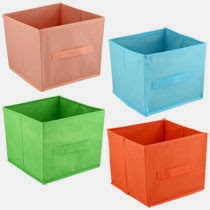
One final caveat. I'm not suggesting a complete (expensive) closet overhaul -- just a re-vision of your space and how you're using it. Even if you can't replace your closet itself with organizers from the dollar store, you might find a few things there that will help you whip this large, rectangular space into shape in a budget-friendly fashion. I'm thinking that the bins below might be a great way to organize my closet shelf.


dollartree.com