Saturday, March 28, 2015

Organization Extra: FlyLady

flylady.net
In one of my earlier posts, I shared that I did a lot of reading before coming up with my own notions of what makes a good, realistic organizational system. One of the sites I enjoyed was FlyLady, who encourages baby steps:
"Our FlyLady system is all about establishing little habits that string together into simple routines to help your day run on automatic pilot."
The site has lots of great ideas, and although I'd choose different starting points, we agree on some things. February's focus, for example, was de-cluttering in fifteen minute increments (an extended Give it Five!)

FlyLady's motto is "Make it fun, it will get done!" While getting organized is not always "fun" for those who've struggled with it for a long time, I agree with FlyLady on the importance of a positive attitude. We can't allow ourselves to give up or to believe that we're somehow inferior because binders and file cabinets don't solve our problems and leave our surfaces clutter-free. Organizing is a process. Taking one step at a time, using our styles as a map, we'll arrive at our destination: organizational systems that allow us to get organized and stay that way.

Thursday, March 26, 2015

Throwback Thursday: On Organization, Right-Brained Thinking and Office Supplies

The post below originally ran on January 30, 2013 after I had the honor of speaking to a local writing group about Organizing by STYLE.

Two weeks ago, I had the privilege of speaking to the Lancaster Christian Writers group on the topic of organization. They were a warm and enthusiastic bunch, and I had a wonderful time.

Among the resources I shared was one of the books that had ushered in a paradigm shift for me, Organizing For the Creative Person: Right-Brain Styles for Conquering Clutter, Mastering Time and Reaching Your Goals, by Dorothy Lehmkuhl. Until I read this book, I'd never considered the notion that people who are right brain dominant organize differently than those who are left brain dominant. Silly, really, since I'd been an educator for years, and firmly believed that different kids had different learning styles and that we could maximize what they learned by using those styles to their advantage. Still, I'd never made the leap to different organizational styles.

But, after I read that book, I sure did. I embraced that concept not only personally but professionally, cooking up style names designed to make organizational concepts fun and accessible for kids, and, as it turns out, adults too.

Then last weekend, I came across a nugget of information in a document I'd downloaded quite some time ago. Smead (the office supply company) had created a document called 100 Ideas for Better Organization. I'd been reading it in bits and pieces, but when I arrived at idea #72 last weekend, I stopped short.

There it was again. Right brain organizing.

Turns out that the need to leave things out in plain sight (one of the personal styles I discuss in my classes and presentations) is connected to right brain dominance. According to Idea #72, the right-brain-dominant person is stimulated to thinking and doing by the things they see.

Well, what do you know? My messy desk has more to do with the dominant side of my brain than my need (?) to operate in chaos.

Smead cascading wall organizer
But, as you can imagine, an office supply company doesn't put out a free publication without taking advantage of the opportunity to advertise their product. In this case, however, I was appreciative, because their "hints" and "suggestions" fed into my mission. When I talk to people about organization, there are two things I want them to know by the time they leave:
  • you aren't broken or flawed or somehow inferior if you struggle with organization and
  • you can turn your styles into assets.
More than halfway through my free download, I discovered that not only was my need to leave things lying out a reflection of my right-brained-ness, but there were office supplies geared to people like me. And you know what that means?

I'm not alone. Better yet, I'm a target market - one who can turn her styles into assets.

Well, that may be the nicest thing an office supply company has ever said to me.

Wednesday, March 25, 2015

Containers: Cutting to the Chase

Overwhelmed by the myriad containers available to organize your space? There are so many choices, both functional and beautiful, that it's easy to get lost in the aisles, trying to narrow the choices. Add responsible shopping (matching your styles and your budget) to the list, and it can be tempting to run screaming from the store, empty-handed.

This chart summarizes what we've been talking about for two weeks: the preferred container qualities for each personal and organizational style. As you look over the chart, think about whether or not the recommendations match your personal preferences. Where can you find crossover? 

As an I need to see it/drop and run person, I can use containers that are clear, color-coded, labeled and/or unusual/unique because these container attributes match both of my styles. My container preference, however, will change depending on what I'm storing and where I'm storing it. In addition, two people who identify themselves as the same style will have different personal preferences. Clear drawers may be a perfect match for one I need to see it person, for example, but be a disaster for another because she can’t see what’s at the back of the drawer.  

What if you've identified yourself as one style, but you're drawn to containers listed in another category? As long as they aren’t containers, furnishings or systems that have proven unsuccessful in the past, give them a shot! There’s no harm in trying different things to get an idea of what works and what doesn’t. 
Remember that organizing by STYLE is all about making your system your own so that it will work for you not just temporarily, but in the long run as well. With that in mind, print the chart out and amend it as necessary to reflect your personal choices. Fill in the blank spaces, and even change noes to yeses -- if those answers will really work for you. I promised you at the very beginning of this journey that there was no one-size-fits-all solution. The more you personalize the chart, the more you'll refine what truly works for you. 
Once the chart reflects your personal preferences, tuck it into your wallet, your purse, your glove compartment or your reusable shopping bag so you have it with you when you go to the store. 
If you’re still in the sampling stage, there are many worthwhile containers to be had at dollar stores, grocery stores and on sale at variety stores. Just keep in mind that while clearance sales and yard sales can be great for finding that perfect, one-of-a-kind container, you may end up frustrated if you find the perfect tool and want to acquire more like it.


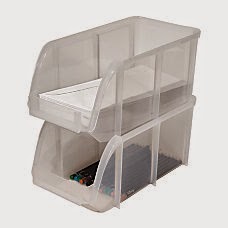
All of variations on plastic drawers in this week's post 
are from office depot.com
If you know just what you're looking for, more power to you! Feel free to buy those perfect containers in multiples if you know they're going to work for you (particularly if you already have some just like them that have been organization-tested). Just keep the receipt in case you over-buy or underestimate in terms of size or usefulness. (Not that I would know anything about that).

Next week's post will close our discussion of containers, as we focus on marrying the materials to the mission.

Monday, March 23, 2015

Containers and the Personal Styles

Containers come in many shapes, styles, colors, patterns and textures. Some are functional, some are fashionable and some strive to be both. Large, small, lidded, open, clear, colored, round, square, rectangular....the choices can be overwhelming.
Despite their variation in appearance, all containers have just three components: form, function and style. Form refers to the size, shape and physical attributes of a container, including features such as lids and sections. Function is exactly what it sounds like - the purpose the container will serve once you get it home. A container’s style comes from its aesthetics - color, texture, pattern, attractiveness.

All of these attributes matter. How much each one matters depends on what needs to go into the container and -- you guessed it -- the personal and organizational styles of the person using it. Your mission will be to try to find containers that will help you to create systems that are both appealing and functional so that they’re easy and fun to use and maintain. 


I love stuff
If you're an I love stuff organizer, the key to containing your belongings lies in corralling both collections and odds and ends. I love stuff organizers may see the containers themselves as collectibles, or as ways to house or display items of importance -- or perhaps both. This tendency to collect things usually means the more you like a container, the more likely you are to use it. 
I love stuff folks often prefer open storage and unique containers that allow them to see what they have. But, since too much visibility can turn into visual clutter (think about the difference between one sheet of paper on a desk and haphazard piles of papers), it’s important to strike a balance between what’s gets displayed and what gets put away. 

For the I love stuff person, container selection is a breeze because almost any type of container works. Clear, color-coded or labeled containers with or without lids can all work well. Clear containers let you see which valuables are inside, while color-coding and/or labeling can be a visual reminder of what goes where. You may also like unique containers because of their aesthetics; in addition, the uniqueness of the container may serve as a visual remember of the location of your valuable stuff. You may want to match containers in terms of color, size or style, or decide on a color scheme or other unifying theme, especially if you want to mix and match containers. The key is to come up with a combination that allows everything to be away, but still visible and/or accessible.


I love to be busy
Time is at a premium for the I love to be busy person, which means the best containers are those that require as few steps as possible. If you're an I love to be busy person, you may benefit from subdivided containers that allow you to see at a glance what’s missing as you hurry from one activity to another. 

Separate storage for each activity (e.g. a separate bin or bag) can also be helpful because this prevents items that are needed for one activity from getting mixed in with materials for something else. Like their I love stuff counterparts, I love to be busy people may also like clear, color-coded or labeled containers that help them keep track of the minutiae of their varied pursuits. And, depending upon their organizational style, they may be able to use each of them with equal facility. 


I need to see it
The name says it all! Anything you can do to appeal to the visual will help you if your style is I need to see it. As a general rule, open storage (no lids) is best because it helps the the I need to see it person put things away without putting them out of sight, preserving the need for visual prompts. Clear, labeled or color-coded containers can work, too, for the same reason - they provide visual cues as to where things go. 
Whereas those with other styles can be coerced into putting their belongings into drawers and closets, I need to see it organizers will resist this. For them, the line between visibility and visual chaos is very, very fine. 
I need to see it folks, like their I love stuff counterparts, often enjoy a visually stimulating mix of containers -- colored, patterned, unique -- and this variety can help them remember where they put things, making it easier for them to make the transition from leaving it out to putting it away. Avoid monochromatic color schemes; without visual variety to remind you where you put things, you'll quickly become frustrated and return to leaving everything out where it can be seen.


A word about size

Remember how you used to buy your kids clothes with “room to grow” when they were little? Regardless of your style, you can use the same concept when determining the right size for a container: Choose containers that are the right size for what you currently own, with a little space for future acquisitions.


All of the containers on today's post can be found on tenthousandvillages.com.

Saturday, March 21, 2015

Organization Extra: Organizing Inspiration, Julie Morgenstern

barnesandnoble.com
My ongoing quest for organization arose from a need for an attitude adjustment. I was changing offices at work, and I wasn't happy about it. After doing more than my fair share of complaining, I decided to turn lemons into lemonade and to view the move as an opportunity to take control of my stuff and my space.

I started reading books, and the first one I read that resounded with me was Julie Morgenstern's Organizing from the Inside Out. I went on to read others that gave me ideas and support, but in the end, it was Julie Morgenstern's philosophy that informed everything I came up with:

"Our philosophy is that every system should be designed from the inside out, based on your unique goals, natural habits and style, so that your system lasts."

Once I began incorporating this philosophy into my professional workspace, it occurred to me that my students might benefit from learning this sooner rather than later, so I took my show into the classroom. Eventually, Mrs. Hess's crazy lessons on organization became a fifth grade staple, with kids identifying themselves as I love stuff and cram and jam and making adjustments in their organizational plans before they crossed the bridge from elementary school to middle school.

They didn't all need this, mind you. Many of them were well-organized, and while they enjoyed entering monthly drawings to win stuff (tools they could try), the lessons didn't impact their systems
smead.com
much. But those whose self-confidence had taken a hit from years struggling to do what seemed so easy for everyone else? They shared stories, poked fun at themselves and relaxed. Best of all, they smiled. I watched faces change from pinched and dubious to hopeful and optimistic over the course of a class period. Suddenly, these kids realized there wasn't anything wrong with them. The systems had failed them, not vice versa.

When I moved on to sharing these ideas with adults, the same thing happened. Suddenly, people couldn't wait to tackle cluttered spaces, papers crammed in folders, drawers full of who knew what? They experienced renewed faith in themselves and their ability to create order in a way that made sense to them.

When I write and teach about organization, my goal isn't to un-clutter the world. Sure, I hope that people will be able to apply these strategies and make it easier to create spaces that work for them. But what I really love is that moment when they re-discover faith in themselves -- when they realize that failing to organize the way "everyone else does" is not a failing or even a personal flaw. It's a part  of who they are, and given time and the right tools, they can create the level of order they crave in a way that makes sense to them and is manageable.

Apparently you can take the counselor out of the school, but you can't take away her desire to change the world, one person at a time.


Thursday, March 19, 2015

Yes, It Has a Home! (Part 2)

How are you doing with yesterday's task? Too soon to tell? If so, you may want to come back to this post after you've come to the end of your trial period. But, if you're someone who wants to know where you're headed, keep reading.

At the end of the trial period, you'll obviously need to go through the contents of the container. When  you do this, you'll want to sort the contents into three categories:
  • Truly homeless items
  • Items you could not put away (space was too full, out of reach, etc.)
  • Items you could have put away but didn't
Decide which category to tackle first. (If you're using the Give it Five! strategy to do this task, you may not get through a single category in one sitting). Each category has a solution, but some are simpler than others. 


Multi-purpose storage items with lids
that lift off like this one, or are hinged
like the one at the bottom of this post
allow many of the styles to put things
away easily but still look neat.
(This ottoman is from target.com).

Truly homeless items need homes. This sounds easy enough, but in an overstuffed room or one with an organizational system that isn't working, it can be challenging to put things "away." If you can immediately locate logical homes for the homeless items, put them there. If you can't find a logical home for the item and you want to keep it, put it back into the container. (If you don't want to keep it, get rid of it right away if at all possible). If you can, corral all similar homeless items (perhaps into containers of their own, one for each category of homeless item) so that you don't have to re-sort later.

For items that could not be put away, see if you can figure out why this is the case. Do these items have homes that are out of reach, overstuffed or simply inconvenient? Can out of reach or inconveniently placed storage be relocated, or does it need to be replaced by something more useful? If the problem is an overstuffed home, consider making that space your next Give it Five! task.

Once again, we're looking for patterns -- this time with respect to the kinds of organizational tools that go unused. Are there perfectly serviceable drawers or shelves sitting empty, or, conversely, overstuffed? Do you need to dig under the bed or get out the stepladder to access the home for the items in the container? If so, consider replacing them with containers and systems you'll actually use. I'll talk more about container choices in next week's post. For now, return any of the items you want to keep to the collection container -- unless you're ready right now to create space for them "where they belong."

For items that could have been put away but weren't, resist the urge to chastise yourself, and explore the possibility that this was a decision based on style rather than laziness. Once again, you're looking for the "why." 

  • I love stuff organizers often resist putting things away because they enjoy looking at them while I need to see it organizers are afraid that out of sight will also mean out of mind. 
  • I love to be busy and drop and run people often lack time to put things away properly. For these folks and their I know I put it somewhere counterparts, dropping the item into the container was actually a victory in itself, and perhaps evidence that the right container can help build better habits. 
  • Cram and jammers? They're walking a very fine line between "could have but didn't" and "couldn't have stuffed one more thing into the available space." Again, take a moment to savor a small victory. An item that landed in the designated container instead of an overstuffed space is an item that has been spared wrinkles, tears and crumpling. This time.
When it comes to sorting this bin and creating new homes, make sure to find and honor natural stopping points. If you want to make progress without getting overwhelmed, consider setting a timer for a length of time you think you can stick to or plan to tackle one of the above categories and then take stock before moving on. And be prepared to stop after one category. Better to end on a feeling of success than a feeling of frustration. The former leaves you anxious to pick up where you left off, while the latter leaves you dreading tackling what remains.
clipartpanda.com

As always, focus on successes. What things have been put where they belong? Do these items have anything in common? Are they important enough to you that you're motivated to put them where they belong? Or, is there a similarity among the containers or systems you're using to store these things? In both of these cases, you've found a style clue. Leave what's working alone and focus on changing the things that aren't working, perhaps by replicating the systems and containers that you actually use.

Share your successes -- of any size -- by leaving me a comment below.

The trick to using these kinds of containers
well is designating what belongs inside.
Otherwise, they run the risk of becoming
fancy clutter catchers, which is a good
temporary solution, but not a good
long-term plan.
(This storage bench is from target.com)

Wednesday, March 18, 2015

Yes, it Has a Home!


Open, rolling containers that can be stashed
out of sight are an easy access choice for
many of the styles and can be used for
this activity or for storage.
(This one is from The Container Store).
In my last post, I shared the concepts behind the STYLE acronym. By now you know that a positive outlook and confidence in your own abilities (Start with Successes) are necessary ingredients as you develop a plan based on your personal and organizational styles. And if you Take it Slow,  using simple strategies like Give it Five! and Don’t put it down, put it away! you'll see steady progress and avoid feeling overwhelmed.

Which brings us to Y: Yes, it Has a Home.  

When it comes to getting organized, home is simply where an item belongs. Books have homes on bookshelves. Shoes may have a home on the floor of the closet. Pots and pans find homes in kitchen drawers, or hanging from racks over a kitchen island.

Very often, clutter develops because items lack homes. Consequently, things are left lying out (I need to see it or drop and run) or improperly stashed away (I know I put it somewhere, cram and jam), because we don't know where to put them. Sometimes, an overload of stuff (I love stuff) or a dearth of time (I love to be busy) compounds the problem.

Let's look a little more closely at our strategies from the last two weeks. Give it Five! is a clutter-clearing strategy. Don’t put it down, put it away! is a clutter prevention strategy. They can be used separately or together, as we will in this week's task, which focuses on building the skill of Don’t put it down, put it away!

Ready? 
A simple plastic bin or laundry
basket will work for this task,
but you can choose something
prettier if you wish.
(Basket above: Crate and Barrel)

To get started, find a medium-sized container that can be used as a clutter catcher. Set it on the floor of a closet or out of the way in a room where clutter prevails. 

Then for the next several days (or until the container is full, whichever you prefer), every time you're finished with something, follow this routine: 
  1. Look at the item in your hand.
  2. Ask yourself, “Does this item have a home?”
  3.  If it has a home, put it there.
  4.  If it does not have a home, drop it in the designated container.
That's it for now. Tomorrow, we'll talk about what to do at the end  of the trial period.