Saturday, June 13, 2015

Organization Extra: 52 Creative Organizing Ideas

Photo: earl53 via Morguefile
This week's Organization Extra is one big visual: 52 Brilliant Ideas for Organizing Your Home. If you're looking for some interesting, unique containers, you'll find them here. If you're a do-it-yourself kinda person, you'll find directions for the projects here as well. I especially like the fact that he focuses on maximizing small spaces, including those that might otherwise be wasted space.

I know someone who'll love #5...which happens to be one of my favorites as well.

Which one do you like best?

Thursday, June 11, 2015

Throwback Thursday: Surviving Summer To-Do Lists

This post originally ran on The Porch Swing Chronicles in July 2014.

Last Saturday morning, I lay in bed composing my to-do list and listening to the (metaphorical) clock ticking (I have a very quiet bedside clock). It's nearly the end of July, and although I've made a dent in my to-do list, it remains long enough that I know there's more list than summer.

This is not unusual.

Given the fact that it was Saturday, I knew other people in my house would also want my attention, at least from time to time. As my mental list grew longer and longer, it began to seem increasingly unreasonable, so I adjusted my expectations, narrowing my list to a few key things.

While this is all very reasonable and logical, it does little to shrink the actual list, which crouches like a wild animal waiting to pounce just when I'm celebrating presumed progress.

juxtapost.com
Since I can't add any days to the calendar, I've decided on my own plan of attack in order to preserve the rest of the summer with some semblance of both sanity and accomplishment.

Targeted lists. Within fifteen minutes of getting out of bed on Saturday, I knew I needed to dump the mental list onto paper. I grabbed four sheets of lined paper and wrote a heading on each: WHO, WHAT, WHERE and CP.

  • WHO: the catch-all list for the people I've been wanting to get in touch with to schedule a lunch or coffee date.
  • WHAT: the standard to-do list.
  • WHERE: my errand list.
  • CP: Class planning to-do list, perhaps the largest animal in the zoo), broken down into chapters (to read), lessons (to plan) and other miscellaneous, bite-sized tasks. 
Separating the lists by category made each one a little less daunting, allowed me to break enormous tasks (class planning) down into smaller ones and made it easier to find what I was looking for without combing a complex list for a single item. It also allowed me to put similar items together, which made things more efficient. When I'm leaving the house, for example, I need to check only the "where" list to determine the errands I need to run.

Chunked time. Years ago, a friend told me about the Fly Lady website, which advocates, among other things, tackling things in fifteen minute chunks of time. It didn't take me long to become a devotee of timer-setting, a strategy I recommended freely to my elementary students when we discussed tackling organizational tasks that seemed overwhelming.

www.flylady.net
One of Saturday's prime tasks was reclaiming my dining room table. Unfortunately, the table contained many homeless items that ended up being relocated to my office until they could be properly sorted and stored. I set a goal of spending fifteen minutes a day going through everything that got dumped in the office until it all ends up where it belongs. Last night, I discovered that what appeared to be a substantial pile on the counter was actually pretty easy to wrangle, and though my fifteen minutes became 35, the reward was well worth it.

Sampling. When the list is long, it's easy to feel as though I'm making progress in one area at the expense of others. Using the chunked time strategy above, I can make a little progress on several things in one day….and by doing "a little of this and a little of that," I get to keep some variety in my day as well. Admittedly, some days call for a dedicated approach to one task, but sampling a few undesirable tasks (and mixing them in with things I enjoy) helps me to make progress on the stuff I don't wanna do.

Flexibility. I admire people who can set a schedule and stick to it, perhaps because I am rarely one of them. I like flexibility for the same reason I like sampling: there are days I just don't wanna do the things I put on the list. When the items are time sensitive, I don't have a choice, but when they're not and a better offer presents itself, there's often no good reason not to move them to another time. And during the summer, better and more valuable offers (e.g. fun family stuff) seem to pop up often.

Armed with my strategies, I'm ready to tackle the rest of my summer. What strategies work for you?

Wednesday, June 10, 2015

Troubleshooting for Easy Upkeep

Photo credit: Seemann via Morguefile
Did you get a chance to look at Putting it All Together? Check it out by clicking on its title in the previous sentence, or on the new "Charts" tab at the top of this page.

Why am I sending you to a chart? Because it's your road map. If you're honoring these styles, systems and choices, your organizational systems are probably working.


Want proof? Look at a system in your home that's working. Chances are it's simple, attractive and individualized to fit your needs and styles. It's no surprise that these systems are the easiest to maintain.


But sometimes systems break down. Three of the most common reasons for this are:
  • Choosing the wrong container. It's easy to choose a container because it's pretty, the right color or the right price, and sometimes we can even make those containers work. But if a container is too small to be useful, too large for the space, or not a match for your styles, it can be the first domino in the demise of your organizational system. If you really love it, maybe you can find another organizational task for it to fulfill, but if not, let it go and replace it with something that makes your life easier.
  • Choosing the wrong home. I know I put it somewhere organizers often fall prey to this one. Any empty space won't due; choosing an illogical or inconvenient home wastes time and energy, and can also cause an organizational system to come crashing down. Similar items should be stored together, close to the place where you most often use them. And if you use something often, it should be easy to access.
  • Making the system too complicated. Have you ever set up a filing system where your categories have so many subcategories that you can't figure out where to put a simple piece of paper? In the interest of making a system thorough, we sometimes overcomplicate things. When in doubt, default to the smallest number of steps possible. Every style benefits from simplicity because simplicity is easier to maintain.
Alone, none of these is difficult to fix, but they can compound one another. While that can be overwhelming at first, the good news is that one small change can also have a positive domino effect. Choosing the right container or home or simplifying the system can reinvigorate everything.

Never underestimate the power of one small change. Keep it simple and style-specific.

Tuesday, June 9, 2015

Tinkering

publicdomainpictures.net
Tomorrow, we'll do a little troubleshooting designed to help make upkeep easy (as promised), but today, I'd like to share a couple of additions I've made to this blog in the past week.

Along the top of the page, you can now click on tabs that will take you to PDFs of the charts I've posted previously, along with a new chart, Putting it All Together, which lets you summarize the key things you've discovered about your styles. Next to the "Charts" tab is a "Lisa Online" tab with shortcuts to my other blogs, and, as always, if you click on any of the book covers on the right hand side of the blog, you can find out more about the book.

If you like the Organizing By STYLE blog, and would like to receive new posts when they go live, check out the "Subscribe to Organizing By STYLE" box at the top of the right hand column. 


See you tomorrow :-)

Saturday, June 6, 2015

Organization Extra: Whipping that Closet into Shape

Photo: MMAARRSS via Morguefile
Last week, I shared a Buzz Feed post that most of us can identify with -- that inner monologue (complete with the temptation to jump ship mid-project) that plays when we try to de-clutter a space filled with things we love, hate and hate to love.

This week is about the aftermath -- in a good way. 53 Seriously Life-Changing Clothing Organization Tips is full of great ideas for turning that newly organized closet into a neat place, and one that's easy to keep organized.

My favorites are the ideas for keeping clothes from slipping off the hangers. Which do you like best?

Thursday, June 4, 2015

Throwback Thursday: Piles, Collections and I Need to See It-itis

This post first appeared on The Porch Swing Chronicles in October 2014. 

Last night, I took down the birthday cards I had displayed in the dining room. Sounds like a good thing, right? Except the birthday was over a month ago. And it was mine, so I can't blame their extended stay on top of my microwave on anyone else's sentimentality or lack of initiative. This one's all on me.

I didn't leave them up on purpose. And I'm busy, but not so busy that I don't have thirty seconds to take down the birthday cards and put them away, especially since I actually do have an "away" in mind. These aren't homeless items, or even sentimental knick knacks that I intended to leave out. They aren't a physical replacement for a to-do list. They simply became so much a part of the landscape of my dining room that I ceased to see them.

I'm definitely a piler. An "I need to see it," "out of sight, out of mind" visual organizer. But, like so many others who share my special way of organizing the world, I often find myself walking the fine line between useful strategy and insurmountable hurdle. Okay, walking is an understatement. I've camped out there.

And so I suspect that a brief walk through my house (should I be brave enough to embark on such a journey) would reveal countless other "collections" that need to be attended to. In fact, right this minute, as I sit in my living room typing this blog, I can spot four such piles -- without even moving from my seat.
aim4order.com

Why does this happen? How come these things aren't where they belong? I'm not a slovenly person. And I can guarantee you that as soon as I finish typing this, I will right three of these long-overdue wrongs. And it will probably take me less than five minutes.

So why didn't I do it before?

Because until I took down the cards and started writing this blog, I really didn't "see" those "collections." They began as reminders to do something, or to finish something, and as time went on, they blended right into the landscape of the room -- so much so that it took an awakening of sorts to remind me that they were, indeed, out of place.

These awakenings often come in the form of expected company. Knowing that visitors will be arriving, I will look at my house with a critical eye, removing the blinders I wear when I am home alone. For the first time in weeks, I'll see my house as company would see it. Appalled, I'll tidy up, put things away and make my house fit for non-family companions.

Once things have been put away and clear space has been restored, I will revel in the beauty of the uncluttered space. I will remind myself how easy it is to gain that space, and how nice it feels to have order restored. And I will promise myself to try to keep it that way....

....but will stop just short of vowing to do so. Because I know that's a vow I can't keep. I know that when I put things out of sight, they often go out of mind as well. And the fear inspired by that possibility is greater than my need for clear spaces.


So the best I can promise myself is to try to strike a balance. To continue to work toward leaving out only that which it's necessary to leave in plain sight.

As for the rest, I'll keep looking for organizational options that keep things visible but not intrusive. I'm only partway through that journey, but I am making progress.

One collection at a time.

Wednesday, June 3, 2015

The Final Letter in STYLE: Easy Upkeep

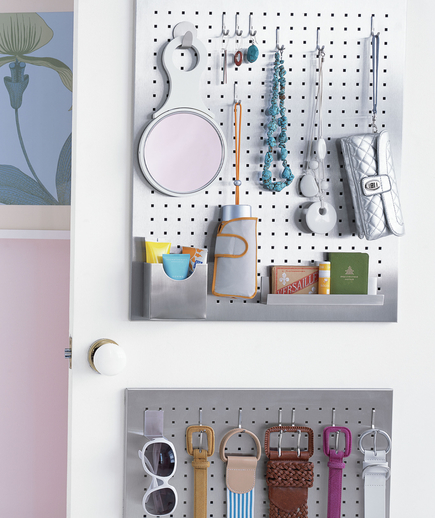
realsimple.com
Easy upkeep. Sounds too good to be true, doesn't it? While maintaining any kind of system requires effort, organizing by STYLE is less exhausting because you're doing what comes naturally. Things are where they belong because the homes you've assigned them make sense to you. Containers work because you've chosen them according to what works for you.

Next week, we'll look back and do a little summarizing and troubleshooting. This week, I'd like to share the three principles of Easy Upkeep.
  • Honor your styles. You've admitted them. You've come to terms with them (or made progress in that direction anyway). You've developed a sense of humor about them. If there's something about them that embarrasses you, you have the freedom to adjust. That said, it's easier to adjust your system than your styles.

  • Honor your systems. Your systems consist of the homes you've established for your things and the containers (from the smallest subdivision of a drawer to the largest room in your house) you've selected to house them. If you've honored your styles as much as possible in the space you have, the resulting systems should flow naturally from what you normally do. 
  • Honor your choices...but remember that not everyone's choices are the same. The whole concept of organizing by STYLE is built around the idea that when it comes to organizing, one size does not fit all. You may love using a certain type of container or storage system, but that doesn't mean that everyone else in your house will appreciate it (let alone use it) as well. If your house is like my house, numerous styles prevail...and collide.
amazon.com
When in doubt, go back to your styles. If your predominant personal style is I like to be busy, a plan that revolves around dedicating more time to organizing is unlikely to be a workable long-term solution. If your preferred organizational style is cram and jam, color-coding the hangers in your closet is likely to be a waste of time and money because while you might hang everything up once, it's unlikely to happen again.

What have you put into place that you're proud of? What still needs work? Share your thoughts in the comments below.