Thursday, February 24, 2022

Then and Now: Notebooks, Planners, and Other Brain Back-Ups


I was just talking about notebooks and planners in my writer's group last week, which is when this post was supposed to run. Apparently my brain really does need back-ups -- I never hit the publish button.
Better late than never? Sigh. It's a process.

Then: 

I am the notebook queen. As a writer, I never want to risk losing a good idea, so I have notebooks in a variety of places: the car, the chest beside my bed, my office, the kitchen. Inside every purse I own.

These notebooks collect my writing thoughts, but they collect other things as well. The titles of books I want to read. Things I have to do. Stuff I want to remember.

As organizational systems go, they're not the best, but I don't expect them to be. Their purpose is to work as a temporary measure until I can get the information where it belongs -- in my calendar or on my to-do list. Without my notebooks, a lot of information would slip away, or, just as bad, I'd be forced to try to remember it all.

I guess you could call them my brain back-ups.

When you think about it, multiples are common in organizational systems. We don't have just one cabinet in our kitchens or one drawer for all our clothes. Multiple tools in various places or serving various functions can be efficient if we have a system for their use. And they work especially well if we use them to target our weak spots.

For me, keeping track of everything in my head doesn't work (weak spot), and seeing reminders of what I have to do does. Sure, I could put it all on my phone, but that doesn't work as well for my I need to see it personal style as going "old school" with paper and a writing implement. And, using notebooks instead of scraps of paper helps keep things contained, as well as limiting the number of places I need to look to see where I might have written something down.

Is there a weak spot in your system? What measures can you put into place to shore it up?

Now: 

The older I get, the more brain back-up I need. As I've shared previously, I have an entire (shallow) drawer devoted to my various notebooks, including several planners that have been pressed into service as a cross between a notebook and a calendar.

Although I still have more notebooks than any one person needs, I've begun to streamline my process a bit so that every notebook in my drawer has a specific purpose, whether it holds plans for a book, interesting markets for my work, or a place to keep track of time spent writing. 

Finding a planner that's set up to mesh well with the way my brain works (a key element to a brain back-up) has helped a lot, taking over the job of a catch-all notebook and making it easier to assign time slots to to-dos. I like it so much, in fact, that I asked for another one for Christmas (and ordered an extra just in case) so I could move seamlessly from one into another when I ran out of pages in the first one. This week, I started Volume 2.

It can take a while to find the right tool and, until we do, it can be easy to convince ourselves that we are the problem. We aren't. A tool should always work in our service and, if we keep our styles in mind and surrender to the inevitability of experimentation (at least sometimes), the journey to the right tool can be fun in and of itself.

Thursday, February 10, 2022

3 Keys Thursday: 3 Steps to Solving that Organizing Dilemma


  Earlier this week, I set out to find a new home for my growing collection of purses. I've been splurging on Kate Spade lately and hanging my purses in the mud room among book bags and jackets was dealing them -- and me -- crushing blows (emotional in my case). 

That's no way to treat a splurge. I needed something that not only gave my new acquisitions the respect they deserved, but made sure the time they'd last justified the numbers on the price tags I'd just removed. In addition, I wanted to keep them accessible. There's no point in owning something you don't use because it's too hard to get to.

I started out by browsing on Pinterest and I got lucky, moving from idea to implementation in one day. Here's how.

Once you've identified the problem:

Identify your styles. This will ensure that you work toward a solution that works for you, not someone else's pretty proposition. Believe me, it's easy to convince yourself that the right tool will solve the problem all by itself. If that tool doesn't also match your styles, that is never the case. 

Brainstorm & browse. I love using Pinterest for this purpose because it makes browsing (getting ideas) and brainstorming (adapting them to fit my space and styles) a two-way street. If I have no ideas of my own, I simply type what I'm trying to organize into the search bar. In this case, it was "purse organization." If I know what I'm looking for (purse hooks, for example), I can get more specific. 

Make a match and try it out. Because I've been organizing by STYLE for quite some time, I quickly zoomed in on style-specific ideas. From there, the next question was whether or not I had the space to implement them. Once I decided on an idea and a location, I looked around for things I already had that would give me a rough idea of whether or not the idea would work. 

I got lucky, finding and implementing a Phase One fix all in the same day. Why a "Phase One" fix? Repurposing something I had works, but I think something else (something I don't already have) might work better, especially since the tool I used was doing another job somewhere else, leading me to have to do a little re-vamping there as well. I ordered something else I want to try from a store I'm familiar with (and whose return policy ensures I'm not stuck with it if it doesn't work). Once it arrives, we'll see if Phase One is a keeper, or if Phase Two works better.

Meanwhile, I've had a couple of days to live with the new solution and, you know what? I love it. If the new hooks don't work in the space, I can stick with this imperfect solution until a better one comes along. If the new acquisition is even better, I can return my placeholder to its rightful place.

As with all organizing, it's a process. Sometimes the first idea works; other times, it leads us to something that does. Either way, we get closer to easy upkeep, one step at a time.

Thursday, February 3, 2022

Throwback Thursday: The Elements of a Container


I’m an educator at heart – and by profession. Consequently, I sometimes look at my Throwback Thursday posts as an opportunity to review basic concepts, especially early in the year when many of us are working on a New Year’s resolution to get organized. Today’s reminder? A post from 2015 on the elements of a container.

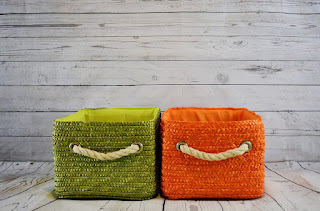
Containers come in many shapes, styles, colors, patterns and textures. Some are functional, some are fashionable and some strive to be both. Large, small, lidded, open, clear, colored, round, square, rectangular....the choices can be overwhelming.
Despite their variation in appearance, all containers have just three components: form, function and style. Form refers to the size, shape and physical attributes of a container, including features such as lids and sections. Function is exactly what it sounds like - the purpose the container will serve once you get it home. A container’s style comes from its aesthetics - color, texture, pattern, attractiveness.

All of these attributes matter. How much each one matters depends on what needs to go into the container, where it will be stored, and -- you guessed it -- the personal and organizational styles of the person using it. Your mission will be to try to find containers that will help you to create systems that are both appealing and functional so that they’re easy and fun to use and maintain. 


I love stuff
If you're an I love stuff organizer, the key to containing your belongings lies in corralling both collections and odds and ends. I love stuff organizers may see the containers themselves as collectibles, or as ways to house or display items of importance -- or perhaps both. This tendency to collect things usually means the more you like a container, the more likely you are to use it. 
I love stuff folks often prefer open storage and unique containers that allow them to see what they have. But, since too much visibility can turn into visual clutter (think about the difference between one sheet of paper on a desk and haphazard piles of papers), it’s important to strike a balance between what’s gets displayed and what gets put away. 

For the I love stuff person, container selection is a breeze because almost any type of container works. Clear, color-coded or labeled containers with or without lids can all work well. Clear containers let you see which valuables are inside, while color-coding and/or labeling can be a visual reminder of what goes where. You may also like unique containers because of their aesthetics; in addition, the uniqueness of the container may serve as a visual remember of the location of your valuable stuff. You may want to match containers in terms of color, size or style, or decide on a color scheme or other unifying theme, especially if you want to mix and match containers. The key is to come up with a combination that allows everything to be away, but still visible and/or accessible.


Alexas_Fotos via Pixabay

I love to be busy
Time is at a premium for the I love to be busy person, which means the best containers are those that require as few steps as possible. If you're an I love to be busy person, you may benefit from subdivided containers that allow you to see at a glance what’s missing as you hurry from one activity to another. 

Separate storage for each activity (e.g. a separate bin or bag) can also be helpful because this prevents items that are needed for one activity from getting mixed in with materials for something else. Like their I love stuff counterparts, I love to be busy people may also like clear, color-coded or labeled containers that help them keep track of the minutiae of their varied pursuits. And, depending upon their organizational style, they may be able to use each of them with equal facility. 


rayedigitaldesigns via Pixabay

I need to see it
The name says it all! Anything you can do to appeal to the visual will help you if your style is I need to see it. As a general rule, open storage (no lids) is best because it helps the the I need to see it person put things away without putting them out of sight, preserving the need for visual prompts. Clear, labeled or color-coded containers can work, too, for the same reason - they provide visual cues as to where things go. 
Whereas those with other styles can be coerced into putting their belongings into drawers and closets, I need to see it organizers will resist this. For them, the line between visibility and visual chaos is very, very fine. 
I need to see it folks, like their I love stuff counterparts, often enjoy a visually stimulating mix of containers -- colored, patterned, unique -- and this variety can help them remember where they put things, making it easier for them to make the transition from leaving it out to putting it away. Avoid monochromatic color schemes; without visual variety to remind you where you put things, you'll quickly become frustrated and return to leaving everything out where it can be seen.

kaboompics via Pixabay

A word about size

Remember how you used to buy your kids clothes with “room to grow” when they were little? Regardless of your style, you can use the same concept when determining the right size for a container: Choose containers that are the right size for what you currently own, with a little space for future acquisitions.


Thursday, January 27, 2022

OBS FAQs: So Many Planners, So Little Time

Maybe you've donated to a number of organizations, and you've gotten them in the mail. Maybe they were 75% off after the new year, and you couldn't resist a bargain. Or maybe you have an I love stuff personal style and just had to bring all the pretty planners home with you.

No matter the cause, you somehow seem to have acquired a plethora of planners and calendars.

Well, have no fear. There's more than one way to press a planner into service.

There's the traditional use, of course -- keeping track of appointments. If you use just one planner and/or calendar, that might still leave you with a small pile of extras. You could:

Use one to keep track of your progress. Perhaps you set a goal to drink more water, take more steps, or read more books. Jotting down your accomplishment of the day in the designated box can help you stay on track. Better yet, it can help you see the big picture (and your successes) on days when things aren't going so well.

Use one to log time spent on your favorite hobby. When it comes to my writing, this has become so important that I don't wait to see if I have an extra planner on hand. I buy one for this purpose. The one I use now is from the dollar store and gives me space to log my time as well as jot a few notes to myself: what I did, and where I want to start in my next session, for example. 

Planning a long-term project. One of my friends gave me a beautiful planner that I use to plan writing projects. While the daily (favorite hobby) planner focuses on the day-to-day and keeps me accountable, this larger planner with tons of open space and BIG blocks lets me do the global planning. When I can give each chapter, character, or concept a full-page spread of its own, I feel less constrained and better able to brainstorm.

Categorized lists. Cross out the month and replace them with a category. I used the monthly layout at the front of my goals planner to keep and track a running list of books I've read, organizing projects I want to do, and 22 things I want to focus on in 2022. (I also used one page to list all the good things in 2021). The page devoted to organizing projects is both a work-in-progress (I add to it as new projects pop up) and a way to keep track (I put a date in the corresponding box every time I work on a project). Because each project gets its own box, I can see the big picture without trying to cram everything onto one list. Depending on your styles, this might not matter to you but, as someone with an I need to see it personal style, once I started doing this, I wondered why it took me so long to try this approach.

A penny (or square) for your thoughts. Or prayer requests. Or anything else you want to get out of your head and onto the page before it floats away. Again, for someone like me with an I need to see it personal style, giving each item its own square keeps things visible in a way that's less overwhelming than a traditional list.

You're probably wondering why this counts as a frequently asked question. You might have guessed (correctly) that I don't have a lot of people asking me what to do with an overabundance of planners. But deciding what to do with an overabundance of anything is an integral part of getting (and staying) organized. Sometimes it's easy. We can look at an item and determine we don't need it or we'll never use/wear it again and we can toss/recycle/donate it accordingly. Or, we can decide we simply don't have the space for something, and decide to give it a new home either through donation or resale.

But a lot of times, it's not so easy. And when something we like and want to keep can honestly be pressed into service in a new and useful way, that can be a win-win. Not only are we getting to keep the thing we like, we're reducing waste by pressing an already manufactured item into service.

There's one final style caveat to consider. If the thing you love is a poor fit for your styles, it might be better off brightening up someone else's space. My primary personal style is I need to see it but, when it comes to stationery items, I definitely have a generous dollop of I love stuff, which makes me more likely to find 1000 excuses to keep all things stationery. But, because planners are an excellent I need to see it tool, it makes sense for me to hang on to them and press them into service in a new way if the planning space is generous enough. Those little year-on-a-page and pocket-sized planners? Not keepers.

So, if you've been staring down that pile of planners and calendars taking up space in your kitchen or office, take a moment and look at them through the lenses of your styles. What abstract ideas or looming projects can they help you organize? How can they help you keep track of your successes and your small steps? What thoughts, dreams, goals and ideas might benefit from being corralled into a collection of 365+ squares separated into 12 months or categories?

And, if the answer is, "they can't," then perhaps the best home for them is the recycling bin. With a clear conscience.


Thursday, January 20, 2022

Then and Now: The Art of No

Now: Regular readers are familiar with my "year of no." It really was a great exercise in learning to stop and think before I commit and, while "no" didn't exactly become a habit, taking time to think through a yes did. 

Then:

Yesterday morning, I wrote about learning to say no. By bedtime last night, I'd already said yes to two new things. In my defense, neither is a long-term commitment, and in one case, it was just the right thing to do.

Still, it seems as though this goal, like many others, might be harder than it sounds. Perhaps there might be some intermediate steps I need to take on the way to my big goal.

Pause. So often, those of us who say yes do so automatically. Simply stopping to think can keep us from making a snap decision that leads to a task that's not such a snap.

Say maybe. Lengthen the pause by not committing either way until you've had some time to think. The bigger the task, the more reasonable "let me think about it" becomes.

Delegate or teach. This works only when you haven't already committed to taking on the task in the first place; reneging on a task you promised to accomplish can come off as irresponsible or even obnoxious, especially if it's not handled delicately. But, if someone else is equally capable of doing the task in question, handing it off can be a very reasonable alternative, especially if the other person is willing to take it on. If someone else is interested in learning how to do the job, taking a few minutes to teach them what to do or assist them in getting started can save you hours of time later on.

If you decide to say no, remember that a little honesty and a lot of kindness go a long way. Explaining an overpacked schedule is preferable to making excuses. Expressing a desire to help at another time or in another way (if you are willing to do so) can make today's no more palatable.

Finally, whether the answer is yes, no or maybe, make sure it's for the right reasons. Balance is key: balancing time, balancing tasks and balancing care for others with care for ourselves can lead to a life that's not only fulfilling, but relaxed enough to enjoy.

Thursday, January 13, 2022

3 Keys Thursday: 3 Questions to Ask Before You Buy


'Tis the season for organizing tools in your inbox! 
Every day this month, I've gotten at least one email from a newsletter or retailer with some tip, trick, or tool that promises to help me get organized. 

Ha.

say that not because I don't think I can get more organized -- I have, and I will continue to improve. I say that because no one tool is right for everyone. All of those well-meaning e-mails operate under the assumption that the tool, tip, or training they're featuring holds the key to organization for everyone.

This is not the case. One-size-fits-all organizing works about as well as one-size-fits-all pantyhose -- or one-size-fits-all anything.

That's not to say that there's no value in the e-mail offers that come pouring in in January, ready to assist everyone who made a New Year's resolution to get organized. But, before you buy:

Stop. Are you excited about this tool? Does it fit your styles? Does it make (or imply) a promise you think it can deliver on?


Think. How will you use this tool? Is it a good fit for your space (or, in the case of a course, a good use of your time)? Can you imagine yourself using it successfully? Does it resemble something you’ve tried but rejected 100 times before? If you have to create space for this organizer, is it worth the space you’re giving up? If you have to make time for this course, is it worth the commitment?


Assess. Why is this item calling out to you? What do you really need? Is there a simpler solution? Do you already have what you need on hand? Is this more of the same or is this really something new?


The last thing we organizing works in progress need is another thing to find a home for or another demand on our time. Before you hit "buy" on that "get organized quick" scheme, make sure it's a good fit for you. If it is (and sometimes it is!), happy organizing!

Thursday, January 6, 2022

Throwback Thursday: Planners by Style


Last week, I wrote about three questions to ask when buying a new planner, but all of them were about the planner itself, and that's only part of the story. When planners (or any organizing tools) work, it's because the interaction between tool and user is a good fit. Choosing a planner (or, again, any organizing tool) is about choosing the one that's best for you.

If you've already taken the styles quiz and know your personal and organizational styles, read on. If not, you might want to take a minute to take the quiz and see which one(s) of the styles below best describes you. 

  • Do you need to see it? I need to see it folks can be very picky about the view. Some like month-at-a-glance, while others are die hard day-by-day planners. Finding the view that works best not for just your life, but for your personal preference plays a role as well. Personally, I need to see white space. A cluttered planner stresses me out, so trying to cram everything into one of those pocket-sized calendars is an absolute guarantee I won't use it, no matter how cute the cover is.
  • Do you like to be busy? I love to be busy folks need calendars that travel easily. Many I love to be busy people choose electronic planners and apps for just that reason. Whether you choose paper or electronic, however, finding a consistent home for your planner is key. A lost planner is of no use whatsoever, and is more stress-inducing than no planner at all.
  • Do you drop and run? Then you need a place to corral all of those appointment cards and reminders or you need a planner that makes them obsolete. Electronic planners or desk planners may rise to the top for this style because it's less likely that we'll set down a device that serves multiple functions and forget about it than a single-function paper planner. Your personal style may also lead the way here. An I love stuff/drop and run person may gravitate toward a different planner than the I love to be busy/drop and run person.
  • Do you know you put it somewhere? Once again, location is key. While personal style may lead the I know I put it somewhere organizer to a particular planner, the most important thing for someone with this organizational style is deciding on a consistent, convenient home for the planner so that it always goes in the same "somewhere." Electronic planners, desk calendars and the ever-faithful kitchen calendar just might do the trick.
  • Do you cram and jam? Electronic planners and apps may be your saving grace. Not only do you not have to worry about deciphering all the information you crammed into a small square on a paper planner, but their electronic counterparts will notify you of all the things you tried to squeeze in as well.
  • Do you love stuff? You, like me, might be suffering from (or reveling in) too many planners from which to choose! Using just one calendar is often your battle. Notice that I said using, not owning. I love stuff is not my primary personal style, but I do love stationery stuff, so you'll find multiple planners in my house. Each has its purpose, however, and when it comes to scheduling appointments, they all must go on one calendar, or you need a plan to integrate your multiple planners. But, take heart, next week's post focuses on some of the things you can do with all the other pretty planners you just had to have.
When styles (yours and the planner's) and functionality align, using a planner is not only easy, but it makes your life easier as well, giving you that much more time to do all the fun things you put into the planner in the first place. 

Or at least to relax, secure in the knowledge that you've written it down, and don't have to rely on memory alone because writing it down takes us one step closer to getting it done.